The most important aspects to think about when coating functionalised particles are outlined below. From the very beginning, those involved in process and product development must define the target parameters, the desired product properties and identify the technological and commercial conditions. Based on these criteria, a suitable technology can then be selected for production. Typically, this is an incremental process that, based on an initial concept, investigates different production variants. The aim is to optimise the process in terms of product properties and costs. There are a large number of functional particle coating applications in a wide range of industries. Important examples include
- protecting the product from environmental influences
- protection of the user from the product
- improving the stability of sensitive products
- the precise adjustment or targeted modification of active ingredient release profiles
- reduction of the hygroscopicity of solids
- the creation of chemically active coatings
- optimised flowability
- changing the surface structure and appearance
- the production of composite particles
- an altered taste and odour.
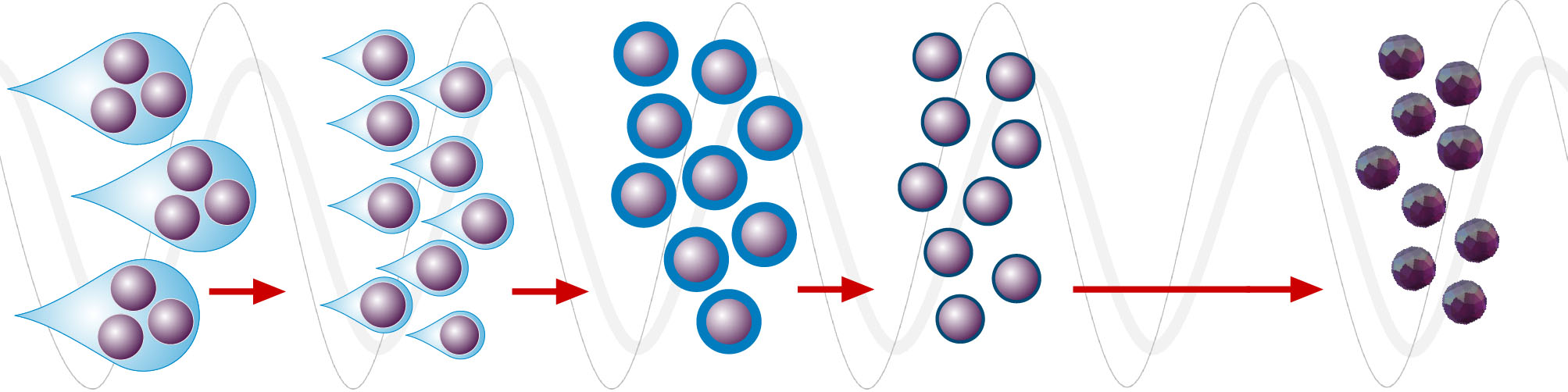
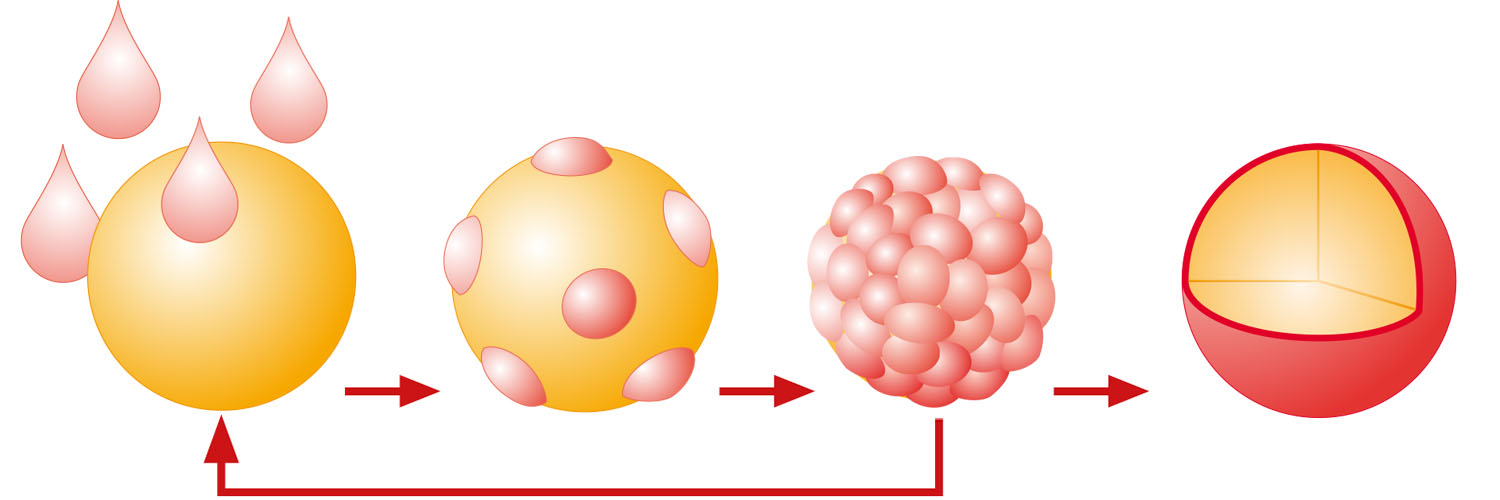
A key aspect in the selection of suitable coating processes is the primary particle size of the material to be functionalised. With small particles (less than 100 µm), for example, conventional coating processes based on fluidised bed applications with liquid injection have certain limitations. How well the liquid can be atomised and what droplet sizes can be achieved both play a decisive role.
Owing to the typical properties of liquids, such as viscosity and surface tension, droplets smaller than 10 µm cannot usually be produced economically. Single particle coating is always more difficult to achieve if the size ratio between the droplet and the primary particle falls below a certain level. If the spray droplets are too large when compared with the primary particles, localised overmoistening occurs; this results in agglomeration effects that negatively impact the coating quality and product particle properties. Particle strength, for instance, can suffer. Depending on the material system, two alternative processes are available for these particle size ranges: core-shell coating during spray calcination or the spray drying of spray suspensions and single particle coating by chemical vapour deposition (CVD).





 Copyright by Glatt
 Copyright: Glatt
 Copyright: Glatt
 The image shows the key visual for the event, the Glatt brand logo, the event logo and the dates of the trade fair