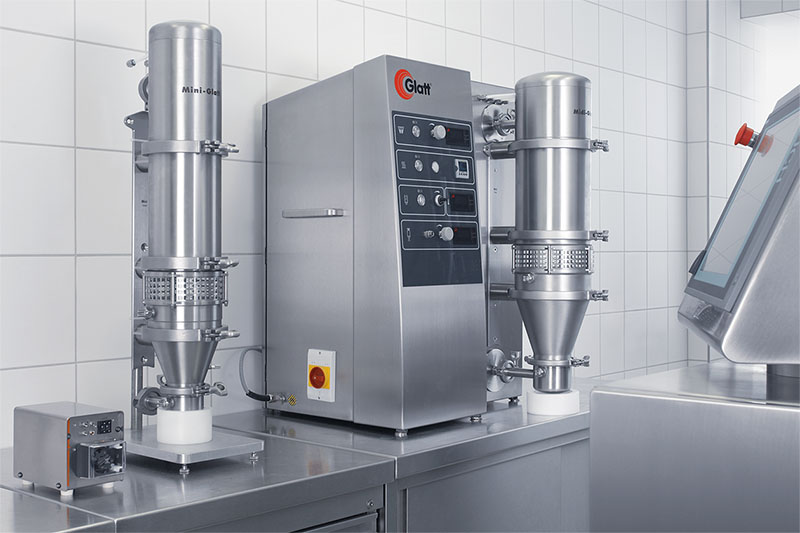
In fluidized-bed agglomeration, powdered raw materials are fluidized by a stream of air. They can then be treated selectively with lecithin mixtures. The intensive contact with the particle surface enables uniform application of the lecithin. The process is used, among other places, in the dairy and instant food industries. With the pilot plant, Sternchemie can now replicate these processes in its own technical center. The goal is to align test conditions as closely as possible with future production and to derive suitable lecithin solutions and process parameters for the respective application.
Development trials can be shifted to the technical center
Until now, Sternchemie has sometimes had to rely on external resources for such development tasks. With the new fluidized-bed agglomerator, product samples can now be analyzed directly in Ahrensburg. This allows for the comparison of different lecithin blends and compounds, as well as their dosages. Process parameters can also be varied during the test series. The data obtained from these tests serves as the basis for further product and process development. This allows development work to be further refined even before testing on industrial production lines. As a result, the effort required for corresponding production trials can be reduced.
Fluidized-Bed agglomeration investigates the properties of instant products
The properties required for an instant product depend on the specific application. Relevant parameters include, for example, solubility, wettability, and foaming. These properties are influenced by the raw materials used as well as by the formulation and process control. The pilot plant makes it possible to investigate these relationships under defined conditions. The effects of raw materials and processes can be systematically recorded and compared with one another. This makes it possible, for example, to determine how different lecithin blends or dosages influence the desired properties of a powdered product.
Pilot plant for fluidized-bed agglomeration expands testing with alternative raw materials
In addition to specific customer projects, the fluidized-bed agglomerator will also be used for further development work. According to the company, this includes, among other things, studies on foam control as well as testing with alternative raw materials. “Thanks to the plant, we can further advance topics such as foam control, functional optimization, and alternative raw materials. In doing so, we are expanding our technological expertise while simultaneously laying the foundation for future product innovations,” explains Kandt. In addition, the plant will be made available for joint development projects within the Stern-Wywiol Group. Applying surfactants can influence various properties of powdered products. These include, for example, stability, processability, and digestibility. The new pilot plant thus provides a technical foundation for initially investigating relevant issues on a smaller scale and determining suitable process parameters for later transfer to industrial applications.
Translated with DeepL.com (free version)




 Copyright by Glatt
 Copyright: Glatt
 Copyright: Glatt
 Copyright: Glatt
 Copyright by Glatt